

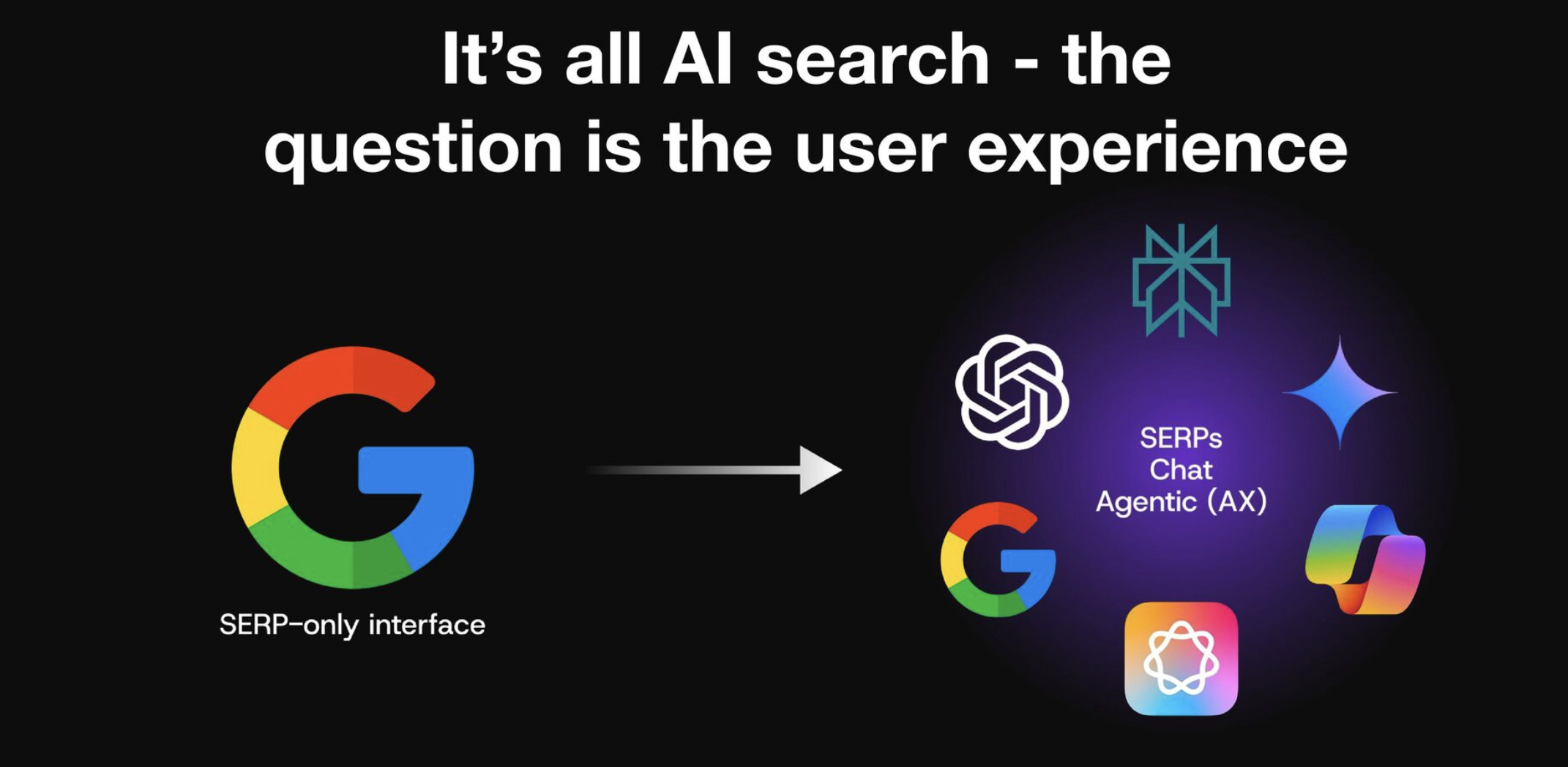

Introduction
This is Part Two of my three-part series that I began yesterday.
- Part 1 (yesterday’s post): Our work in the AI search community, and the major shifts that affected our customers and audience.
- Part 2 (this post): New product features and innovation from the DemandSphere team in 2025
- Part 3: What we’re seeing in 2026, and what we’re focused on next.
This post will cover the very busy year we had as we launched not one but two new products on top of the DemandSphere platform, in addition to a whole array of new features and improvements on our existing products.
TL;DR: 10 Takeaways from our 2025 Product Updates
- We expanded DemandSphere from SERP analytics into full LLM and Gen AI tracking, integrated into the same platform and pipeline
- DemandMetrics is now two modes on the same core platform: SERP analytics and Gen AI analytics, enabled by features turned on or off
- We shipped major performance upgrades to support dramatic growth and new enterprise scale workloads
- We dealt with Google’s pagination changes and can now provide top 5 SERP pages by default and top 10 pages on request
- We upgraded TSR (our version of the Top 20 dataset) and Share of Voice so clients can do live recalculations with SERP feature filtering, including AI Overviews
- Search Intelligence (formerly SERP Intelligence) now supports multiple BigQuery schemas, including flatter reporting models for cost effective BI at scale
- We added GA4 analytics views for LLM referral traffic, including breakdowns by source like ChatGPT vs Perplexity vs Copilot
- We launched Rewind for both SERPs and LLMs, including Chat Rewind with archived ChatGPT style responses
- We were first to market on key Gen AI analytics features including AI Mode tracking and query fanout data at scale
- We launched Analytics AX, expanded rule based keyword group and tag management, and saw record demand for APIs, now moving toward v5.1
The DemandSphere Platform
By way of technical explanation, the DemandSphere platform is a petabyte-scale streaming data pipeline built specifically for large-volume analytics on unstructured SERP, LLM, and third-party API data from sources such as GA4 and Google Search Console in highly-dimensioned, ontological schemas that closely represent any number of business structures, mapped directly back to content, campaigns, organizational units, and other variations.
Our product lineup is as follows:
- DemandMetrics: our core analytics platform, the flagship product & APIs
- SERP Intelligence (soon to be renamed to Search Intelligence): our BigQuery-based fully managed data warehouse that pipelines data directly from DemandMetrics into data warehouses and BI solutions
- Analytics AX (new from 2025): our large-scale log analytics platform
A year ago, we did not have any tracking or analytics capabilities for LLMs.
The closest we had was tracking capabilities for AI Overviews (AIOs), within the larger context of SERP analytics.
Decision point about LLM tracking
There was a choice to make: do we stick with SERP analytics only or do we embrace tracking LLMs as part of our core offering?
For me personally, it was an obvious choice. The search experience is changing and it would be shortsighted for us to not embrace these new experiences.
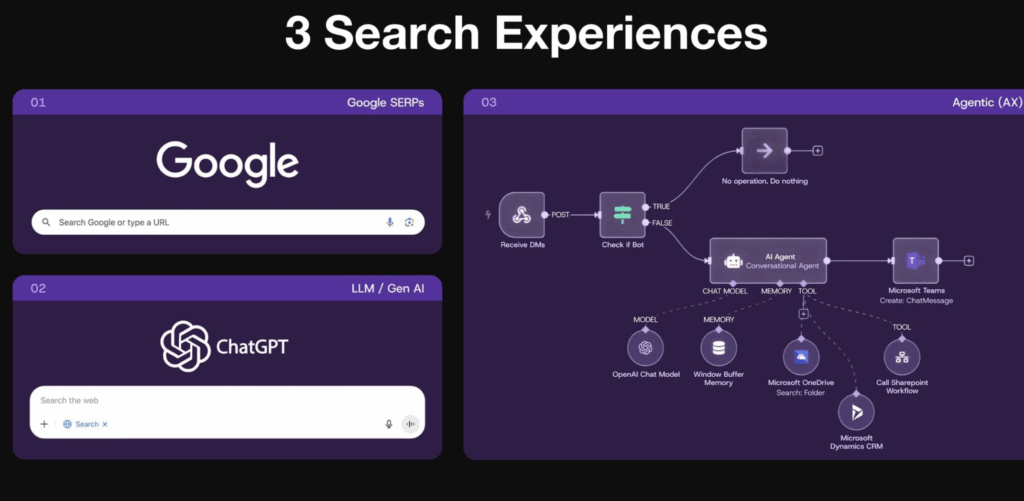
Since the arrival of generative AI experiences, search has evolved from one core experience (SERPs) to three:
- SERPs
- LLMs / generative AI, chat-style
- Agentic (which includes APIs)
The debate, for us, was never about whether we were doing traditional vs. AI search.
This dichotomy doesn’t even make sense to us, because it is all AI search.
It was a question of are we going to limit ourselves to only one experience or embrace all three (and potentially additional ones down the road).
We chose to embrace all three and jumped in with both feet.
By the end of Q1 2025, we had our first LLM tracking capability. Since that time, we have added more LLMs, and numerous new product features. Many of them we have not even yet had a chance to announce yet and our website is being completely redesigned to reflect this update to our product suite as a whole.
Our team worked faster than they ever have before and we managed to be the first to market with a few key features in the LLM analytics space.
We also managed to do this without any external funding and we are proud to be considered, on a regular basis, in product selection processes alongside the top 2-3 other leading platforms.
As a result of these changes, we are now the only platform in the industry that can handle, at the level of depth that we handle, both SERP and LLM analytics in a single data pipeline. Customers can choose if they want to use only our LLM analytics features, only our SERP analytics features, or both, in hybrid mode.
The Updated Product Suite
As a result, our product suite now looks like this:
- DemandMetrics:
- DemandMetrics for SERP analytics
- DemandMetrics for Gen AI
- SERP Intelligence (soon to be renamed to Search Intelligence): we are renaming it to Search Intelligence because it encompasses more than just SERP analytics.
- Analytics AX (new from 2025): our large-scale log analytics platform
DemandMetrics for SERPs and for Gen AI are seamlessly integrated, it’s all just a matter of features turned on or off based on what customers need.
In the rest of this post, I’m going to go through the major feature and platform upgrades we shipped across DemandMetrics, Search Intelligence, and Analytics AX. Some of these are new capabilities, some are upgrades to pipelines and data models, and some are things we built because we had to move fast as the market changed and our customer base scaled.
New Features and Platform Upgrades
Below is a list of the most significant new features and platform upgrades carried out in 2025.
Performance upgrades
In 2025, we grew dramatically as a business and we had a lot of new large enterprise customers join. In fact, it was our highest revenue year so far.
With that growth, and with the nature and complexity of the data that we have at large volumes, performance started to become an issue on certain screens.
We spent a lot of time architecting additional database clusters and setting up our infrastructure to better support faster use of this data. There are still some additional improvements that we need to make and that work is already underway. However, we have made great progress and users have already reported better satisfaction overall.
Dealing with pagination updates
This was in response to Google’s removal of the num=100 pagination HTTP parameter. This was a interesting process for a couple of weeks but we have arrived at a solution where we can provide the top five SERP pages by default.
For all of our clients and for clients that need the top 10 pages we can provide that at no additional charge as well.
Updated TSR model with live Share of Voice recalculations
TSR is our acronym. It means Top Search Results and it is in other platforms the parlance will generally be something like Top 20. We call it TSR in most cases because it’s a more sophisticated data structure than some of the traditional top 20 data structures that we have seen.
We have a lot more data around pixels and different types of SERP features, and nested SERP feature data. One of the great features about the DemandSphere platform is that you can apply different parameters and filter into different groups and filter in Google SERP features, like AI overviews, and filter them out and you can get on the fly live Share of Voice (SoV) recalculations.
That’s an important feature for many of our clients. We made some significant upgrades to our TSR model over the last year and upgraded all of our clients.
It is one of our most widely used features by far.
New SERP Intelligence schema support
Our initial SERP Intelligence schema in BigQuery was designed for exploratory use cases. It’s a nested schema this is extremely granular, providing pretty much any element found on the SERPs and LLM responses.
This is great when you’re doing ad hoc research.
When you’re trying to scale reporting and business intelligence at large volumes that can start to be an issue. You can have cost and performance issues.
So, in addition to this exploratory schema we have introduced new, flatter schemas based on the TSR data structure and others that allow clients to have both the exploratory features and the reporting features for faster and more cost effective reporting on long term trends.
Multiple CTR model support
We now have the ability to support multiple click through rate models (CTR models).
This is used for calculating things like potential traffic. The days of standard CTRs across all websites are long gone, there is a need for per-site and even per-segment (within a site) level of granularity in CTR modeling.
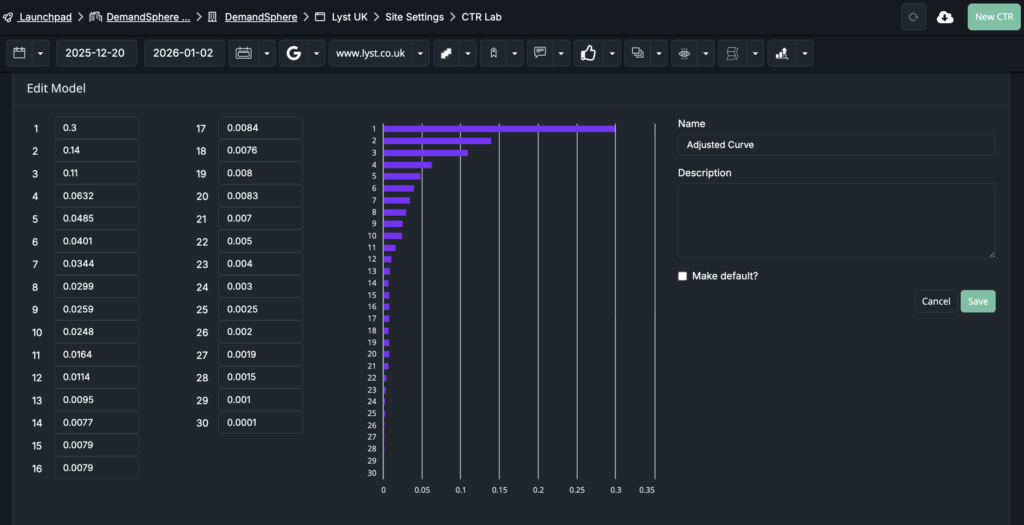
In CTR Lab, a feature we’ve had for a long time, we’ve had the ability to view different CTR models.
This is a further enhancement that allows you to get that at the potential traffic calculation level. We have some additional improvements planned for this overall feature set in 2026.
GA4 analytics for LLM traffic
We have had a Google Analytics integration with DemandSphere for many years and now we added a view for LLM traffic analytics. The challenge with LLM Traffic analytics in GA4 is LLM search traffic is not considered as a channel.
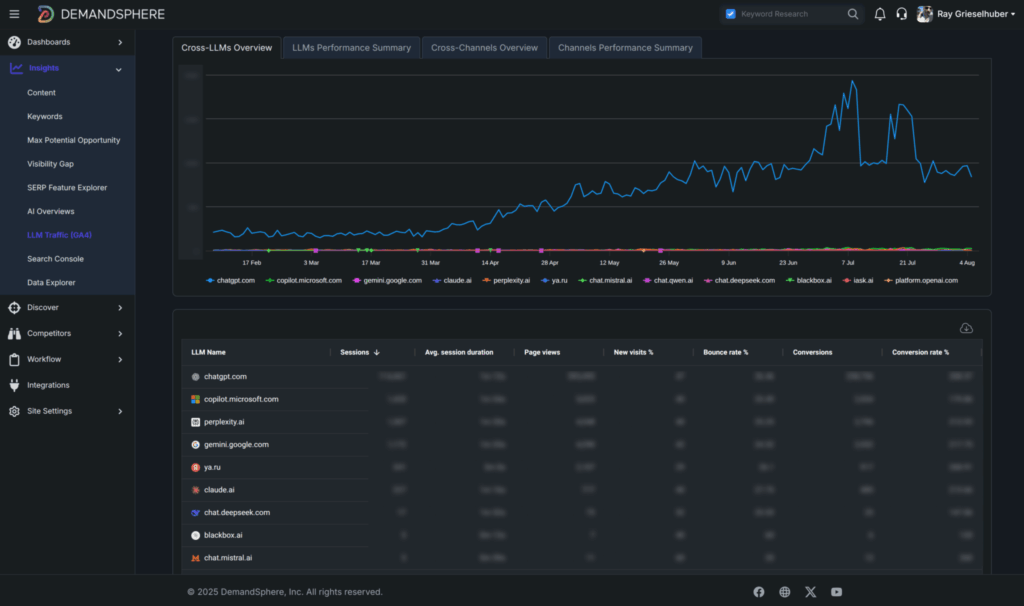
It’s a referral source. One of the challenging aspects of dealing with GA4 analytics in general is there’s not a great way to have custom channels. You have to spend time configuring those and you are always caught between this dichotomy of referral sources versus pre-supported channels.
So, without making things too complicated, we have a view now that allows you to see the different core metrics related to GA4 such as traffic, conversions, revenue, bounce rate, and so on.
We’ve also taken all of the different regular expression mapping for referral sources to map against all the different LLM traffic sources so that you can see, for example, your traffic breakdowns of ChatGPT versus Perplexity versus Copilot, and more.
This is a very popular feature as well.
Chat Rewind (in addition to SERP Rewind)
Longtime users of DemandSphere will know that we have a feature called SERP Rewind, which allows us to archive HTML snapshots of the SERPs that goes back for as long as they are a client.
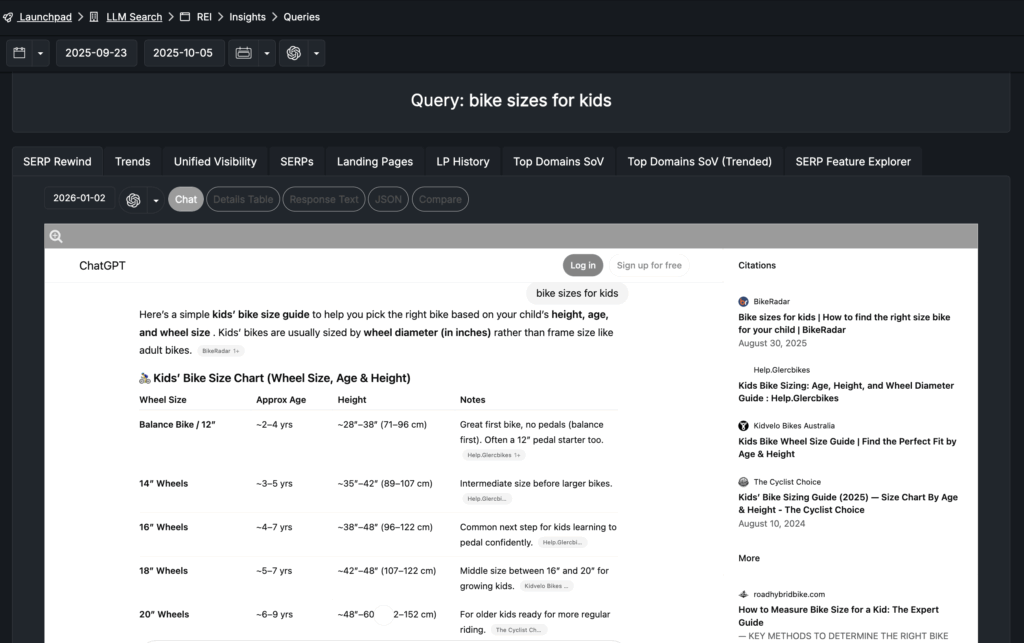
We have now introduced the same functionality for LLM tracking called Chat Rewind.
More generally, we have been calling this feature Rewind, but it encompasses both SERP Rewind and Chat Rewind. You can see the archived LLM interface responses such as what you would see directly within ChatGPT.
This is a yet another popular feature and most of our clients tell us they haven’t seen this anywhere else.
LLM tracking capability for ChatGPT, Perplexity, Gemini, and more
This was the big initial enhancement that we made at the beginning of 2025 and it unlocked everything else.
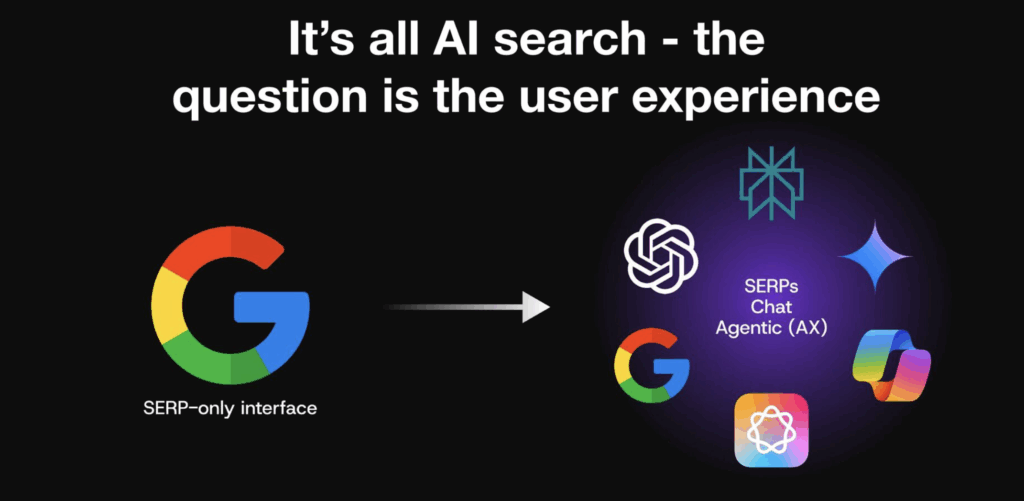
The good news is, is that we were able to integrate this tracking capability directly into all of our existing data pipelines which gives us a lot of advantages of scale and other feature capabilities.
This was the basis of our new DemandMetrics for Gen AI product launch.
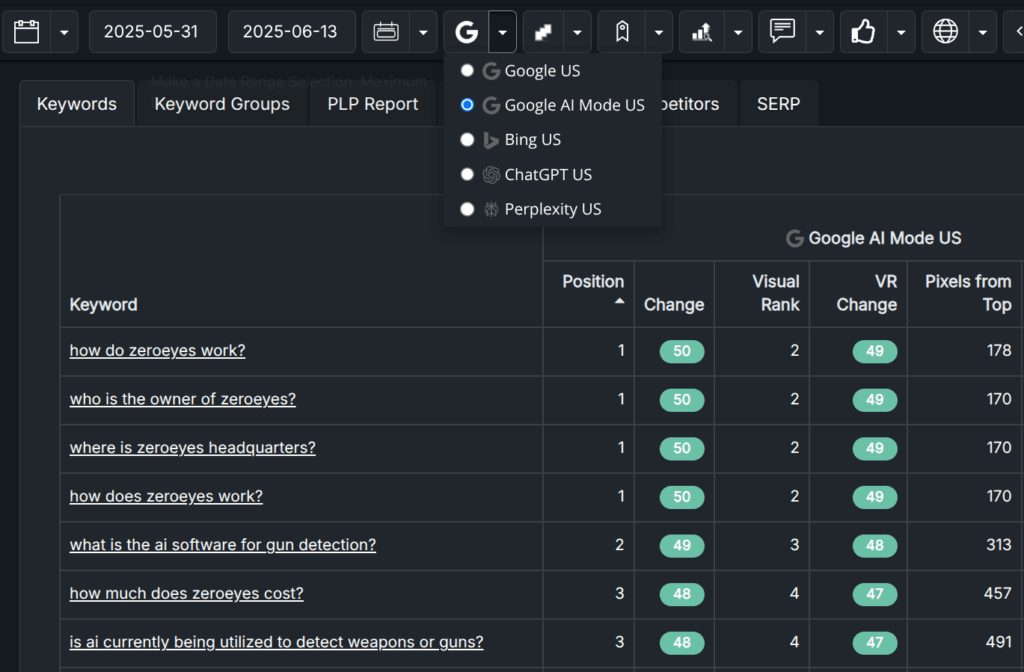
AI Mode tracking
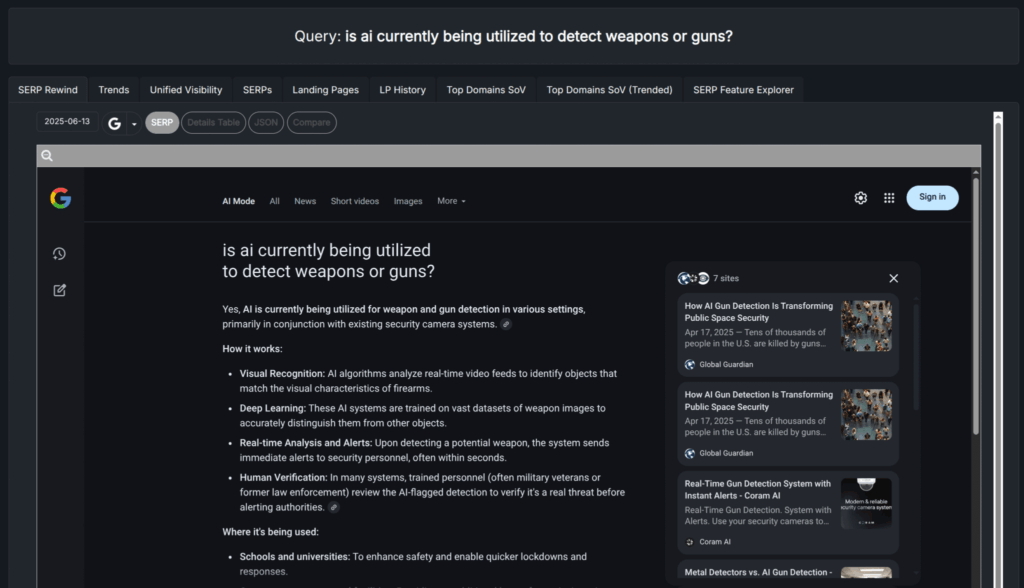
We are actually the first company in the market to launch AI mode tracking. We launched it within less than 24 hours after it was announced in public availability within the US market.
And, of course, the Rewind view:
Citation tracking
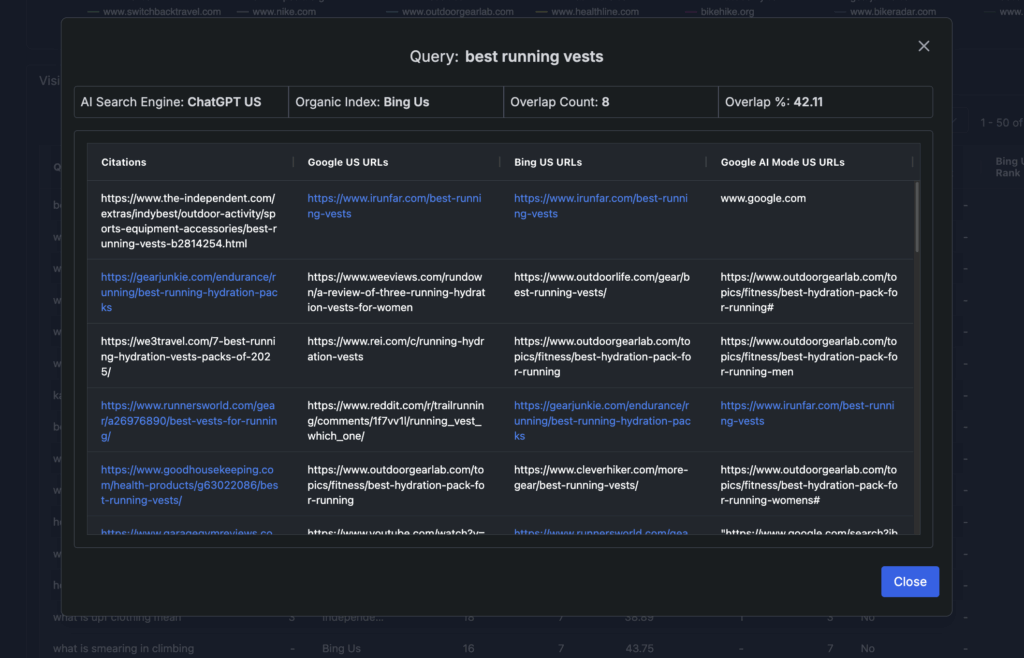
This comes along, of course, with the LLM tracking capability. Our citation tracking gets a ton of usage and it was one of the most requested datasets to be made available via API.
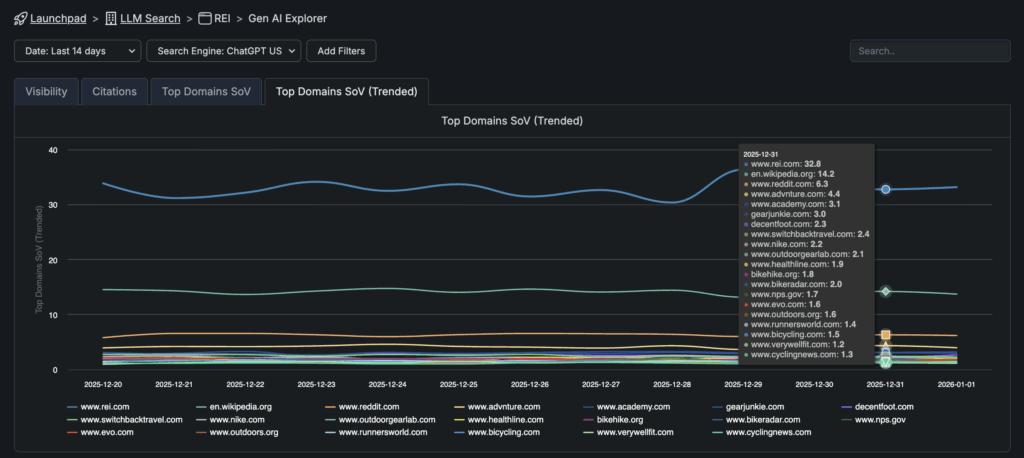
It’s similar in this way to our TSR model because the citation data, at the end of the day, within the LLM responses is basically the LLM extracted reflection of that underlying index powering AI search in ChatGPT and others. Yet again, the index is the prize.
Brand Management
Of course, everyone wants Brand Management.
However, we didn’t see a lot of great implementations, so we decided to spend some extra time on this to really get it right. This is used heavily within our Mention tracking which I will be talking about in the next section.
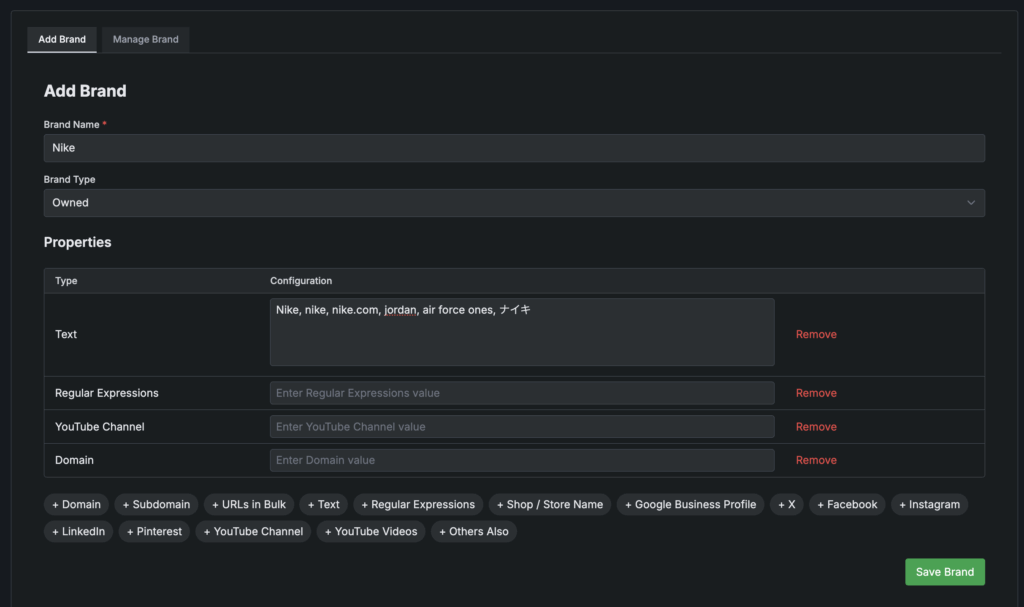
When we did a survey of the Mention tracking in other platforms, we were surprised to see a quite simplistic view of what gets tracked as a brand.
To use Nike as an example, the mention tracking would simply look at the string “nike” and call it a day.
This doesn’t really work for any major brand, especially global brands. You have different languages, well-known product lines (such as Air Jordan), slang renderings, social campaigns, and much more. Additionally, you need to be able to manage these complex entity relationships for brands for all of your competitors too.
All of this can be handled in our version of Brand Management.
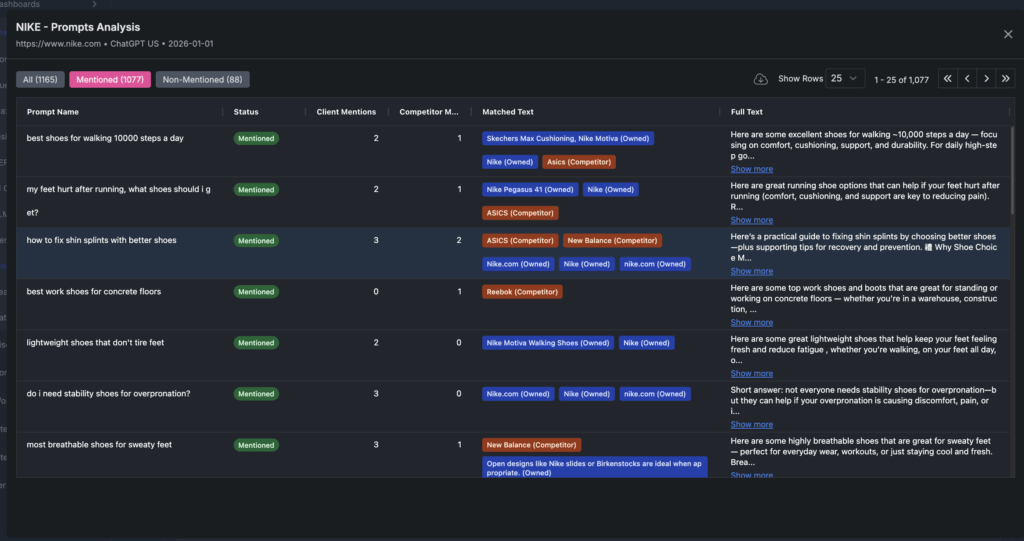
Mention Tracking
Mention tracking, in addition to citation tracking, is a big part of LLM tracking overall.
With our approach to Brand Management, mentioned above, we have the most flexible system for tracking mentions, both for your brands, partners, and also competitors.
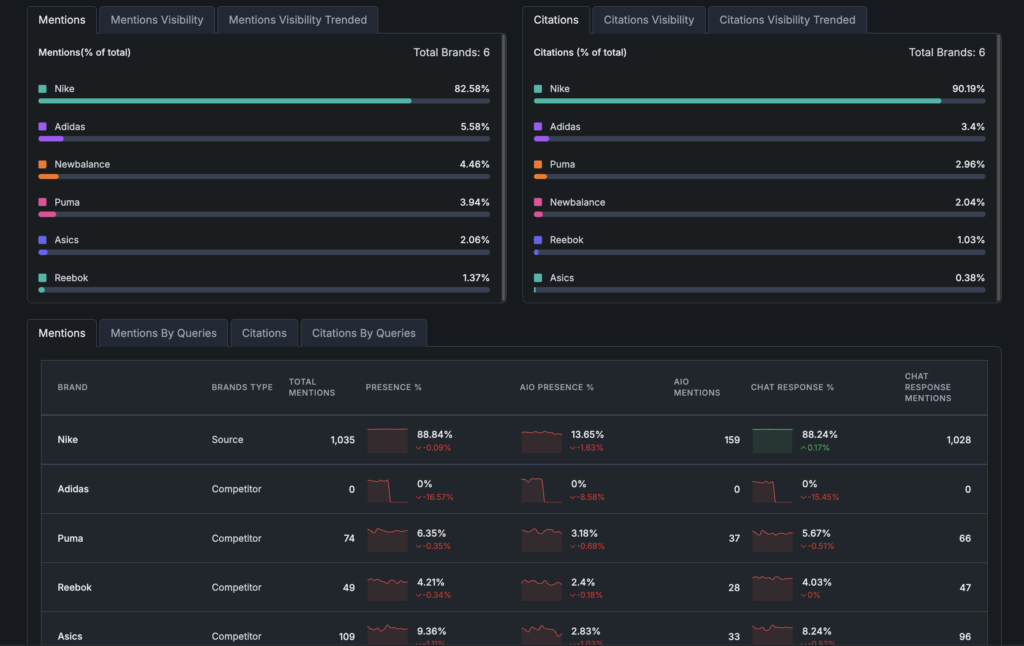
You can get an up to date view of the latest prompt and mention tracking, and even see exactly what was matched for the purposes of counting it as a mention.
Query Fanouts
With the launch of AI Mode, Query fanouts became a priority topic in the community because people want to understand what the LLMs themselves are prompting in order to get additional search results, which in turn allow the LLMs to provide more comprehensive results back to the user.
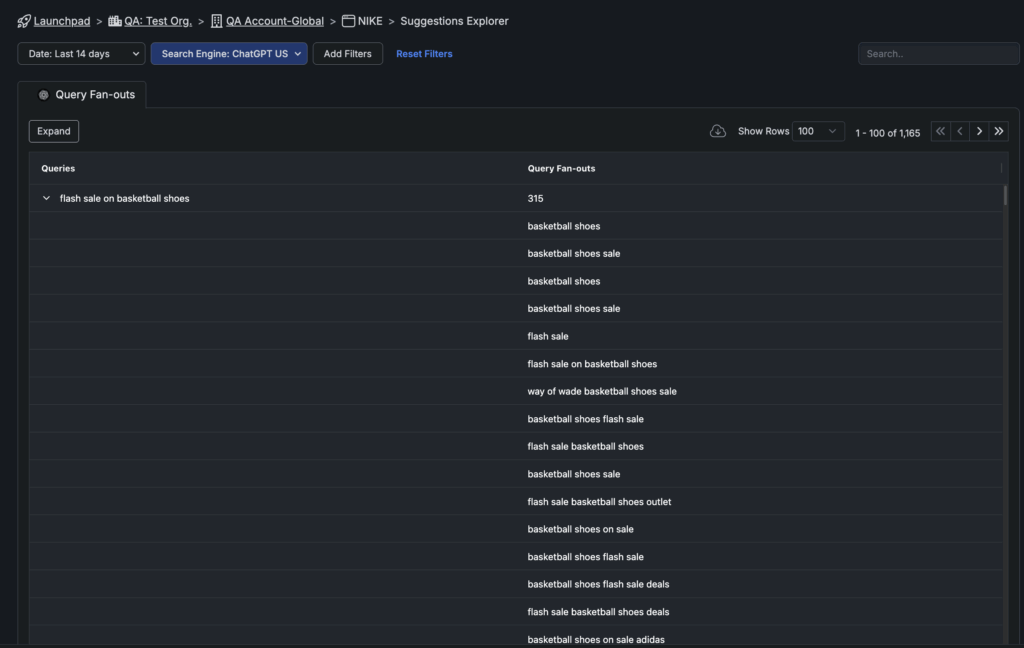
If you don’t understand the underlying query fanout data, you don’t really know how the LLM is thinking about the topic that you’re trying to monitor. So we have Query Fanout data for ChatGPT and other LLMs and we’re going to continue to expand on this.
This has been built directly into our Suggestions Explorer, which is one of the best tools for conducting prompt research on grounded data sources.
We were, againm the first platform to provide Query Fanout data at this sort of scale in our platform application. Mike King mentioned us at Tech SEO Connect last month in Durham and he also noted that we are the first platform to provide this capability.
LLM data in SERP / Search Intelligence
As I mentioned above, the platform, our Data Pipeline and BigQuery is currently called SERP Intelligence.
We will be renaming this to Search Intelligence because now we handle more than just SERP data, with our LLM analytics.
So you can access LLM data directly from BigQuery. We’re seeing a lot of teams adopt SERP / Search Intelligence in such a way that enables them to manage three separate datasets: analytics data (such as GA4), Google Search Console Bulk Export, and DemandSphere data, all in the same project. The insights that people are getting from these combined views are power.
Personas
Persona management for LLM tracking is in beta now.
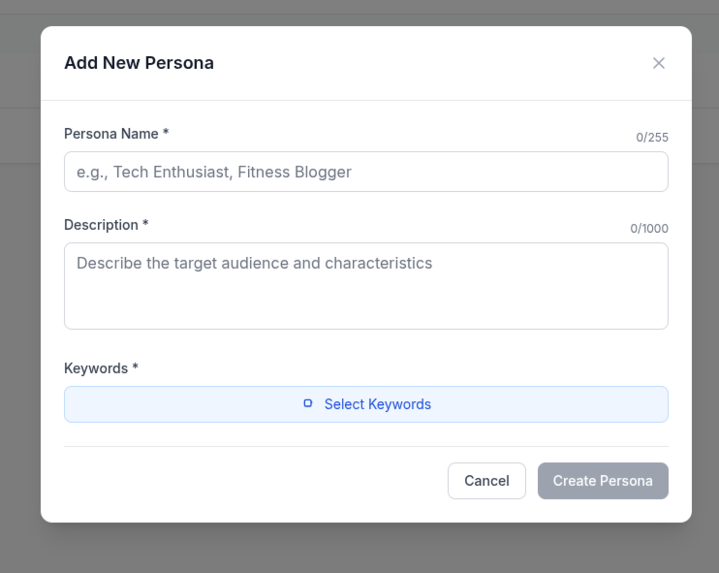
This is an obvious upgrade for prompt tracking because you need to be able to map topic + intent + persona for the most accurate understanding of your brand’s visibility.
Analytics AX
Another big one was one of our new products which is called Analytics AX.
Analytics AX is a very interesting product, as it is an enterprise-scale log analytics platform. Historically, it has been a challenge for marketing teams to get log data because IT security teams view it as a risk, which is understandable.
However, given the executive-level prioritization around AI, this is changing and there are new opporunities for teams to make the case that it is necessary in order to understand how LLM bots are interacting with the site. This can also yield insights about agentic use cases, depending on the nature of your digital products and APIs.
We can integrate with Cloudflare, Vercel, Cloudfront, and more. You can also send data via S3, SSH, and more.
This allows us to get log analytics data at any scale at an affordable rate. It also allows people to do ad hoc queries, because, with our platform, you get direct access to the underlying logfile data structures.
The sky is the limit in terms of the type of insights that you can get from this data.
We’re going to be doing a lot more with this dataset in 2026 and we’ll be bringing some of these views directly into DemandMetrics from Analytics AX.
Rule-based Keyword Group / Tag Management
We also launched rule based keyword group and tag management.
With our larger client installations, we have had hierarchical keyword group management for a long time. This means you can have multi-level, nested groups.
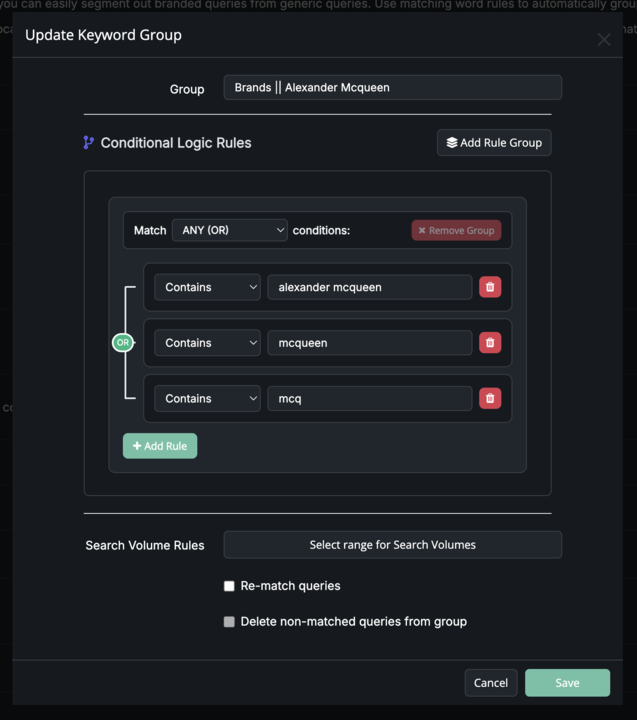
This works quite well overall but for complex taxonomies, the regex approach can be cumbersome.
As a result, we added a new, rule-based option. It’s a simple feature switch, so if you’d like to use rule-based mapping instead of Matching Word Rules (which includes regex), simply contact Support and we will turn it on for you.
APIs
We have launched version 5.1 of our APIs into beta.
We have seen, in 2025, more requests for APIs to our data than we have seen in any previous year.
We’ve always had demand for it, and we’ve always had support for some of our data via API. However, to be honest a lot of our clients were just using exports and SERP Intelligence, because it is very easy to just query the data in BigQuery.
With the advent of MCP and other protocols, we’re seeing a lot more demand for our APIs. So, this is an area in which we are devoting more energy and we will have a lot more on this to share in 2026.
Even more coming in 2026
That covers the bulk of the features and platform upgrades we shipped in 2025.
Some of these were foundational, some were customer driven, and some of them were simply us moving as fast as possible as the search experience changed.
We’re not slowing down in 2026.
What’s coming in 2026?
UI improvements
We generally get a lot of great feedback on our UI. It is, however, a heavy hitting product and can be a little overwhelming at times for new users, until they have been trained.
We are aware of this and are working on some improvements in 2026 to simplify onboarding, improve onboarding videos and documentation, and simplifying some of the user experience.
Additional Performance Enhancements
As one of our specialties is large-volume analytics, with very complicated data structures, performance is something that we are always paying attention to.
It’s a constant challenge but we have innovated on some great new architectural improvements in 2025 and we will be building on this foundation in 2026 for even faster performance across the board.
More APIs
As I mentioned we’re also going to be doing a lot more with APIs.
Most of our APIs are geared toward reporting use cases now but we will have some exciting announcements to share around dynamic APIs as well. Stay tuned.
Even more to come
In addition to all of that, we have a ton more features either on the roadmap or already being built. I can’t yet share what those are but we were working on the next generation of AI search analytics and it will continue to push the boundaries of our industry.
Conclusion
It has been a great year at DemandSphere from a product perspective. As always, we’re keen to hear from you and our audience.
Send me your comments and questions and feature requests and, and all that and it’s something that we are excited to continue to dig into.
Part 3 of this series launches tomorrow!