We spend our days watching how brands show up across AI search. ChatGPT, Gemini, Perplexity, AI Mode, AI Overviews, and the Google SERP.
To do that well, we have to track the models behind all of it. Which labs ship what, how good it is, what it costs, and whether you can run it yourself.
That work adds up to a picture of the whole frontier and today we are publishing that picture as a single tool.
The State of Frontier AI is a new free tool in DemandSphere Radar. It is built from the same data as our AI Frontier Model Tracker: 81 models from 17 labs across 4 countries, updated as new models ship.
What it shows
The model tracker answers “how good is this model.” This page answers a bigger question: what does the whole field look like right now and also provides insights on model quality for various types of tasks and workflows.
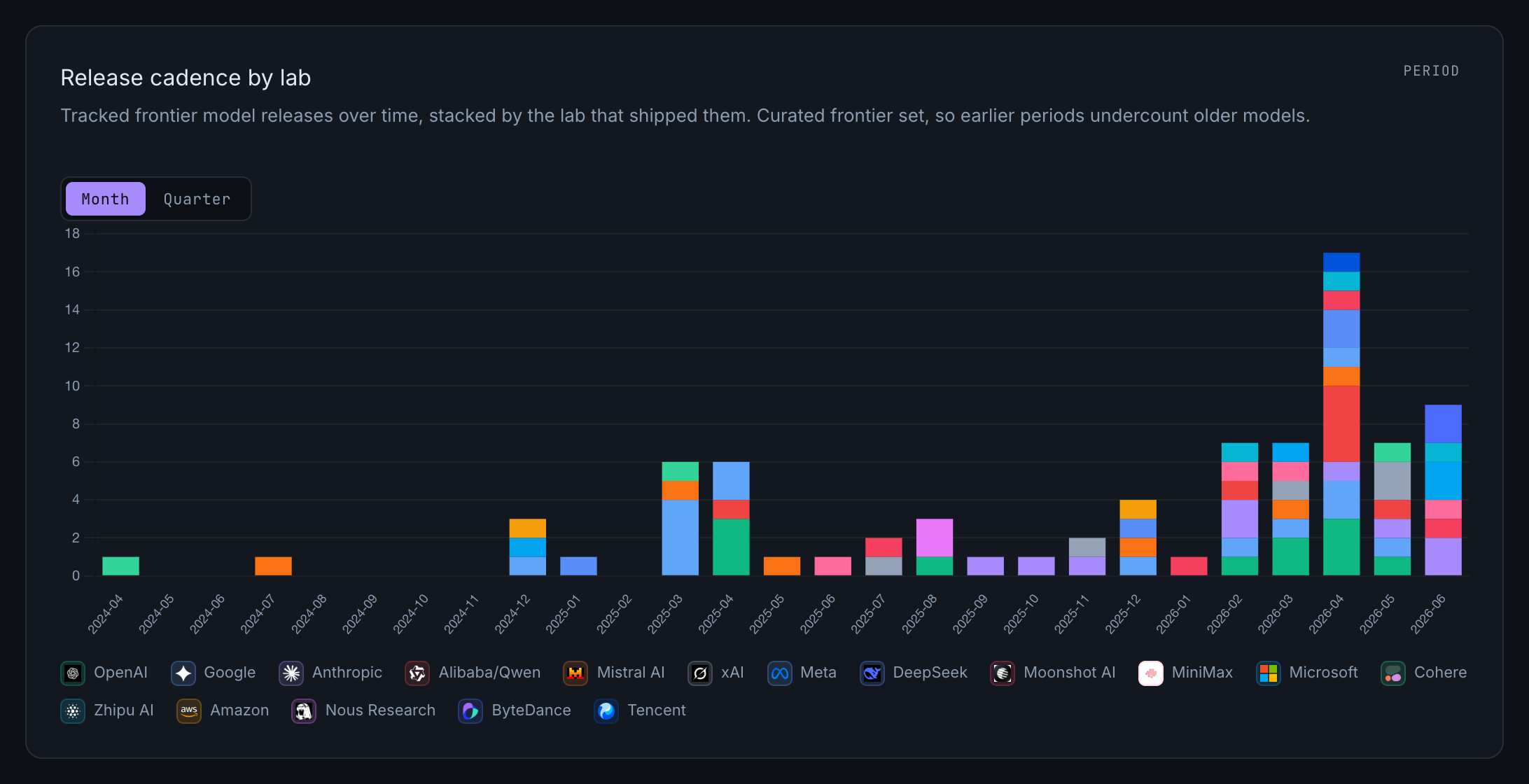
Release pace. When each lab ships, charted over time, with toggles for lab, country, and open or closed weights. The frontier moves on a rolling release cadence now, not annual launches.
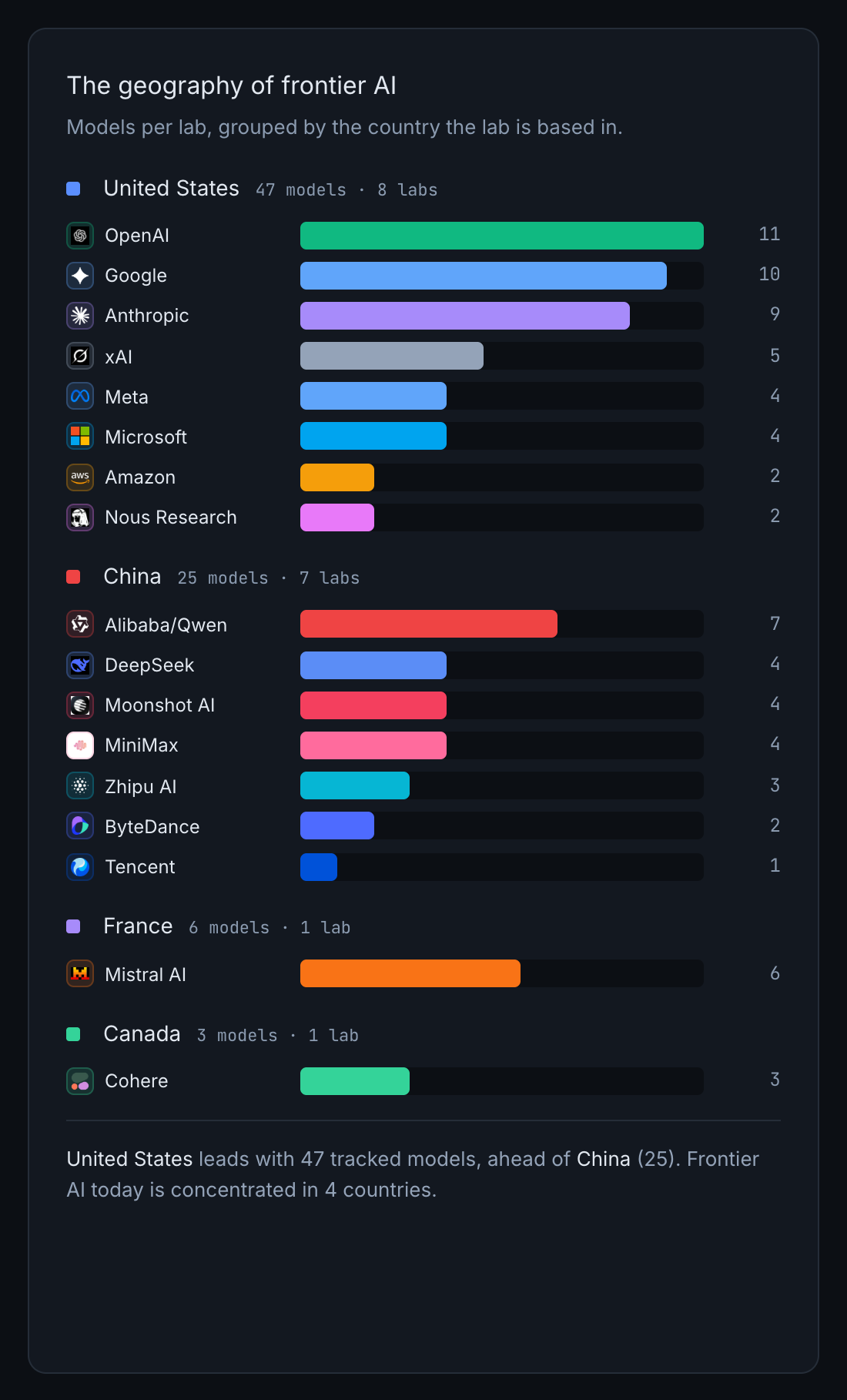
The geography of frontier AI. Models per lab, grouped by the country the lab sits in. The United States leads with 47 tracked models across 8 labs. China is second with 25 across 7. France and Canada round out the four.
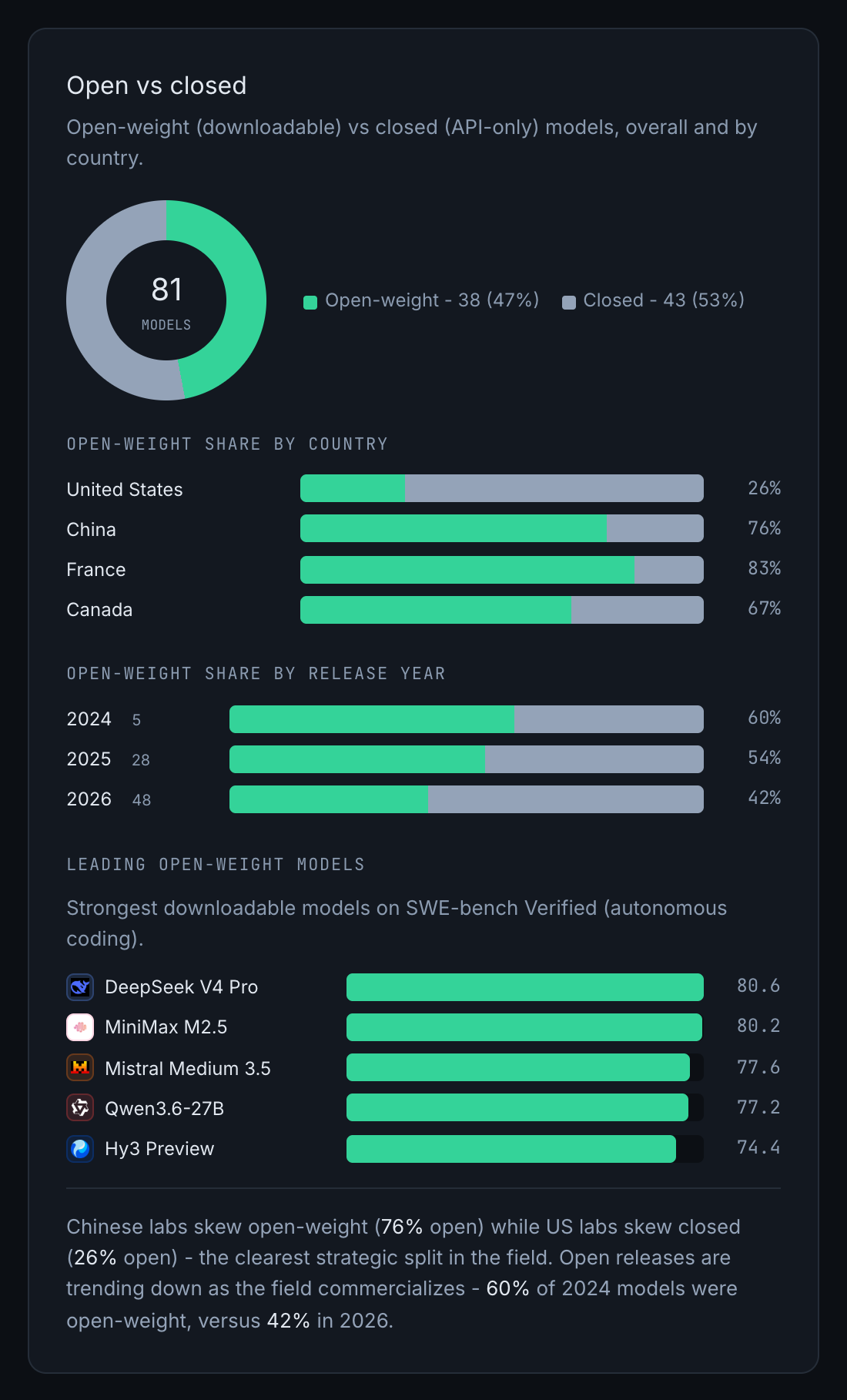
Open vs closed. This is the clearest split in the field. Chinese labs ship open: 76% of their models are open-weight. US labs ship closed: only 26% of theirs are. And across everyone, the open share is falling as the field commercializes - 60% of 2024 models were open, versus 42% in 2026.
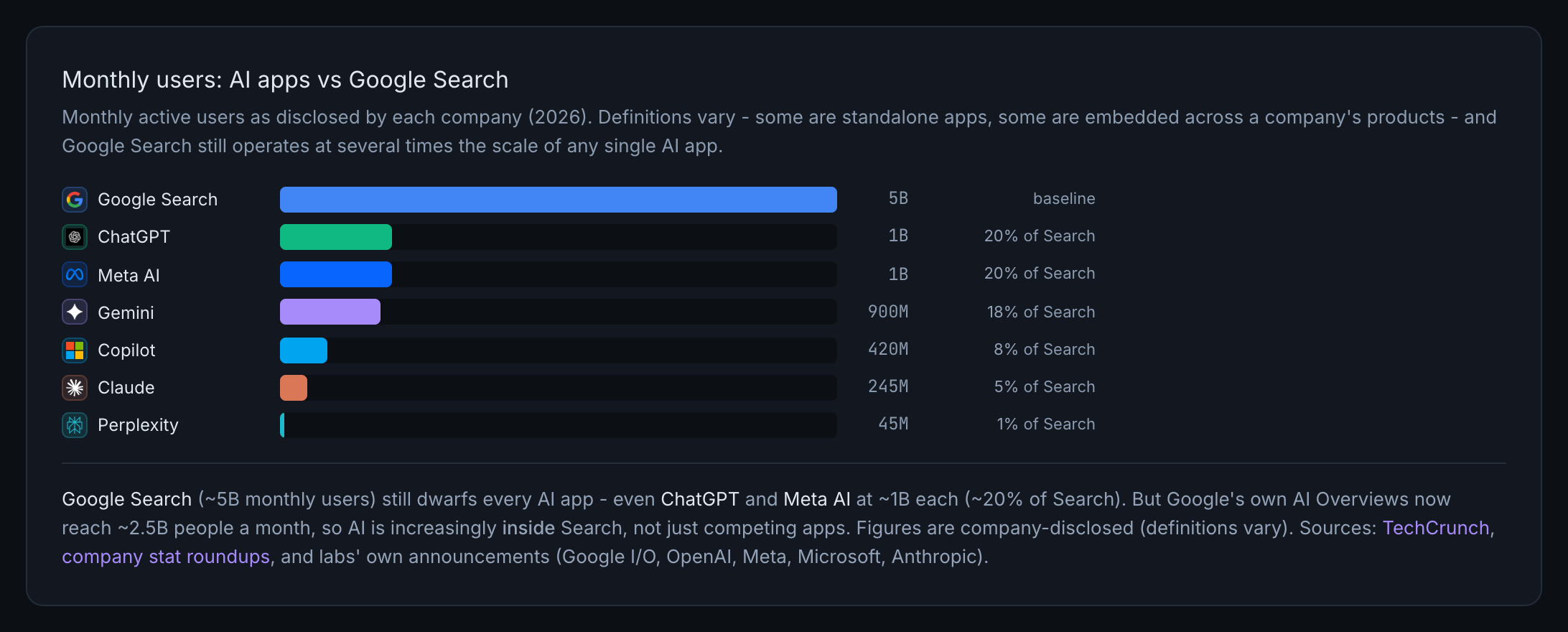
Real usage. Benchmarks are one thing. Reach is another. We compare each company’s own disclosed monthly user numbers against Google Search. Google Search still runs at several times the scale of any single AI app - around 5 billion users to roughly 1 billion for the largest apps. The gap is closing. It is still large.
Run it yourself. The open-weight frontier is now strong enough to self-host for real work. We show the best open models for coding and inference, and the hardware to run them.
The agent layer. The agent types in production, the open and closed frameworks behind them, and the agent, skill, and connector marketplaces growing around them. The tooling layer is splitting the same way the models do - open frameworks you self-host versus proprietary products you buy.
The money. Revenue by lab, the move into ads and commerce, and where the valuations sit. The labs are still figuring out how to pay for all of this.
Why we built it
We built it because we needed it ourselves, which is why we build much of our toolset.
Our platform tracks brand visibility across these models and the products built on them. To do that, we have to keep a current read on who is shipping what and where it is heading.
That read was scattered across a dozen tabs and stale blog posts. So we put it in one place, kept it current, and made it free. It is also included in the API / MCP server for the AI Frontier Model Tracker.
The same reason holds for all of Radar. Most of the data about how search and AI are changing is spread thin and goes out of date fast. We think it should live in one place and stay current.
What’s next
This page updates as the tracker does. New models, new labs, and new countries show up here as they ship.
More Radar tools are coming. If it helps people understand how search and AI are changing, it belongs in Radar.
See it at demandsphere.com/research/demandsphere-radar/state-of-frontier-ai/.