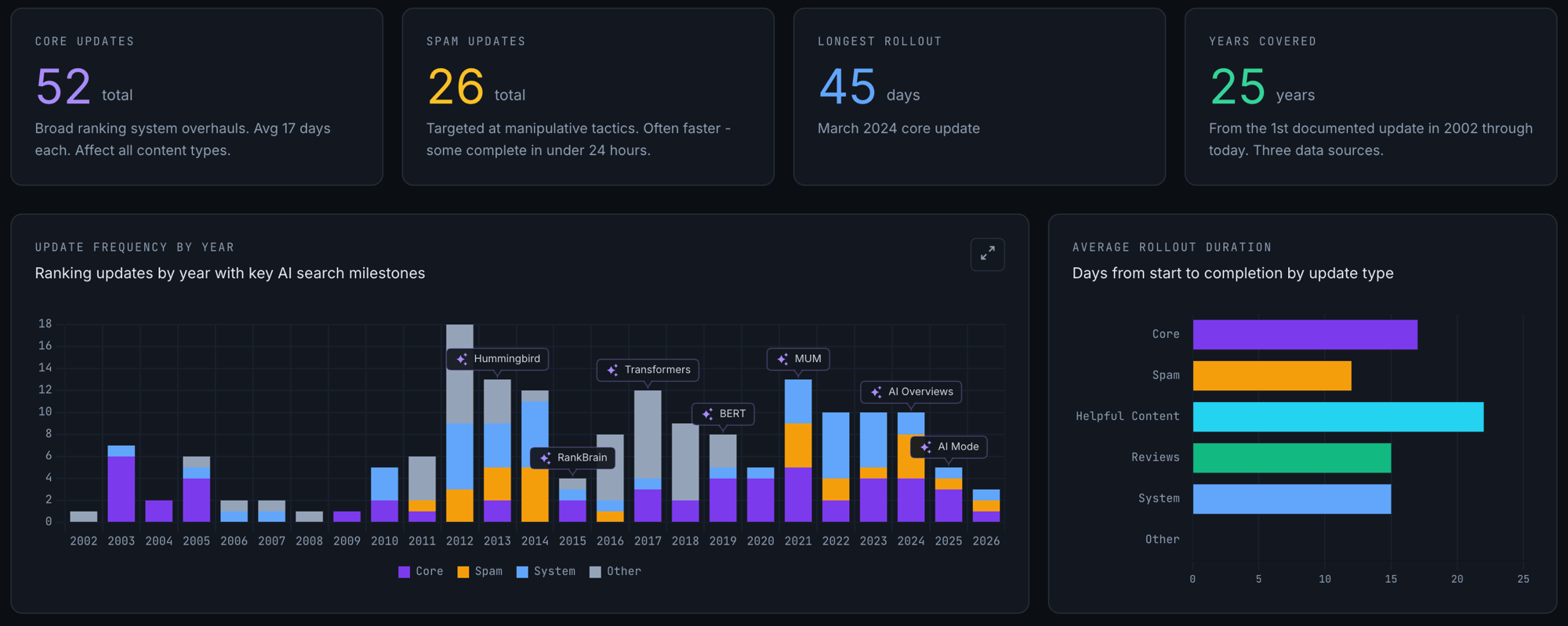
The Google Algorithm & AI Search Update Tracker tracks every major Google Search ranking update and AI innovation since 2000, covering 170+ entries over a 25 year time period.
There are three data sources including, of course, Google’s Search Status Dashboard.
We’ve released this as free tool, with a JSON API.
We built this primarily because it’s a tool we needed ourselves so we can integrate it into our platform but, as always, if one team needs it, usually that means many more do as well.
At DemandSphere, we track brand visibility across Google SERPs, AI Overviews, ChatGPT, Perplexity, and every other AI search platform.
When a Google core update rolls out, the first question our customers ask is: “Is this an algorithm change or something else?”
That question is harder to answer than it should be.
Google’s Search Status Dashboard only goes back to 2021. The SEO community’s historical records are scattered across blog posts, tweets, and tools that come and go. And nobody was putting the algorithm updates and the AI innovations on the same timeline.
We’ve been building our own dataset to track this in our Annotations database so users can easily overlay any of these changes on their charts in our dashboards.
Google Search has been AI search for over a decade
This is the part most people miss, and it’s something we talk about a lot.
The popular narrative says AI search started in 2023 with ChatGPT or SGE.
That’s wrong. Google has been weaving AI into its ranking systems since 2013.
This is why we always say “it’s ALL AI search.”
Here is a summary of the major innovations that Google has introduced into its search platform:
| Year | What Google shipped | Why it matters |
|---|---|---|
| 2013 | Hummingbird | Rewrote the core algorithm for semantic understanding. Queries stopped being keyword bags. |
| 2015 | RankBrain | Added machine learning to handle the 15% of queries Google had never seen before. |
| 2017 | Transformers | Published “Attention Is All You Need.” The architecture behind GPT, BERT, Gemini - everything. |
| 2019 | BERT | Applied deep NLP to 100% of English queries. Google called it the biggest leap in 5 years. |
| 2021 | MUM | Multimodal AI. 1,000x more powerful than BERT. Understands text, images, 75 languages. |
| 2024 | AI Overviews | Generative AI in the main results. The biggest SERP layout change in a decade. |
| 2025 | AI Mode | Fully conversational search. Chat-style interface with cited web sources. |
The recent changes made the AI visible to end users.
But the ranking system has been AI-powered for years. If your SEO strategy only accounts for AI Overviews, you’re looking at the last few steps of a long-running project.
We wanted a tool that puts the algorithm updates and the AI milestones on the same chart.
When you see Hummingbird, RankBrain, BERT, and AI Overviews alongside the core updates, the trajectory is obvious.
What the tracker does
The tracker shows every major Google ranking change from 2000 to today.
Each entry has a date, type, duration (where known), and a researched description of what changed and what was affected.
You can filter by type (Core, Spam, AI, System, Other), filter by year, search by name, sort by any column, and expand any row for details.
The frequency chart breaks down updates by year and type, with AI milestones annotated above their bars. You can expand the main chart to full screen.
Every entry has a hash link, so you can share a direct URL to #florida or #bert and it’ll jump straight to that row and expand it.
Where the data comes from
We use three sources:
Google Search Status Dashboard - Live data from [status.search.google.com](https://status.search.google.com/), fetched on every page load. This covers 2021 to present. When Google confirms a new ranking update, it shows up in the tracker automatically.
DemandSphere historical database - We’ve tracked Google algorithm changes in our annotation database for over 20 years. This covers the pre-Dashboard era: Florida (2003), Penguin (2012), Panda, Hummingbird, and every named update through 2020. We imported this data directly from our production systems.
Google Research publications - AI milestones sourced from Google’s research papers and product announcements. These are flagged in the tracker with a sparkle icon so you can tell them apart from ranking updates.
The full dataset is available as a free JSON API under CC BY-NC 4.0. No auth, no rate limits. Build whatever you want with it, we only ask that you provide proper attribution back to DemandSphere.
Why we care about this at DemandSphere
Our platform monitors brand visibility across both traditional SERPs and AI search platforms.
Every core update changes the SERP landscape. And every AI development, from BERT to AI Overviews, changes how Google decides what to show and where.
Understanding this history helps our customers and our team think about search as a system that evolves, not a set of rules that change randomly.
The March 2024 core update absorbed the helpful content system. AI Overviews changed the click-through metrics, among many other things. AI Mode is changing both the query and also the user journey.
How to use the tracker for your SEO & AI search workflow
When you see ranking changes in Search Console, open the tracker and check the timeline.
Use SERP Rewind to compare what the results page looked like before and after.
If there’s a confirmed update rolling out during your volatility window, you know what type it is, how long it typically takes, and what it targets. That saves hours of guesswork.
For longer-term planning, use the type filters. Look at all the core updates together. Look at how the spam updates evolved from Penguin to SpamBrain. You can also see how the gap between AI milestones keeps shrinking.
The API is there if you want to build this into your own dashboards or alerting systems. Pull all core updates, filter by date range, feed it into your reporting.
What’s next
This is the second tool in DemandSphere Radar, our search intelligence initiative. The first tool, which we announced last week was the AI Frontier Model Tracker.
We have more features planned for the overall DemandSphere Radar set of tools, which we’ll talk about a little more in our next post.
The tracker is at demandsphere.com/research/demandsphere-radar/algorithm-update-tracker.
The API is at /api.json.