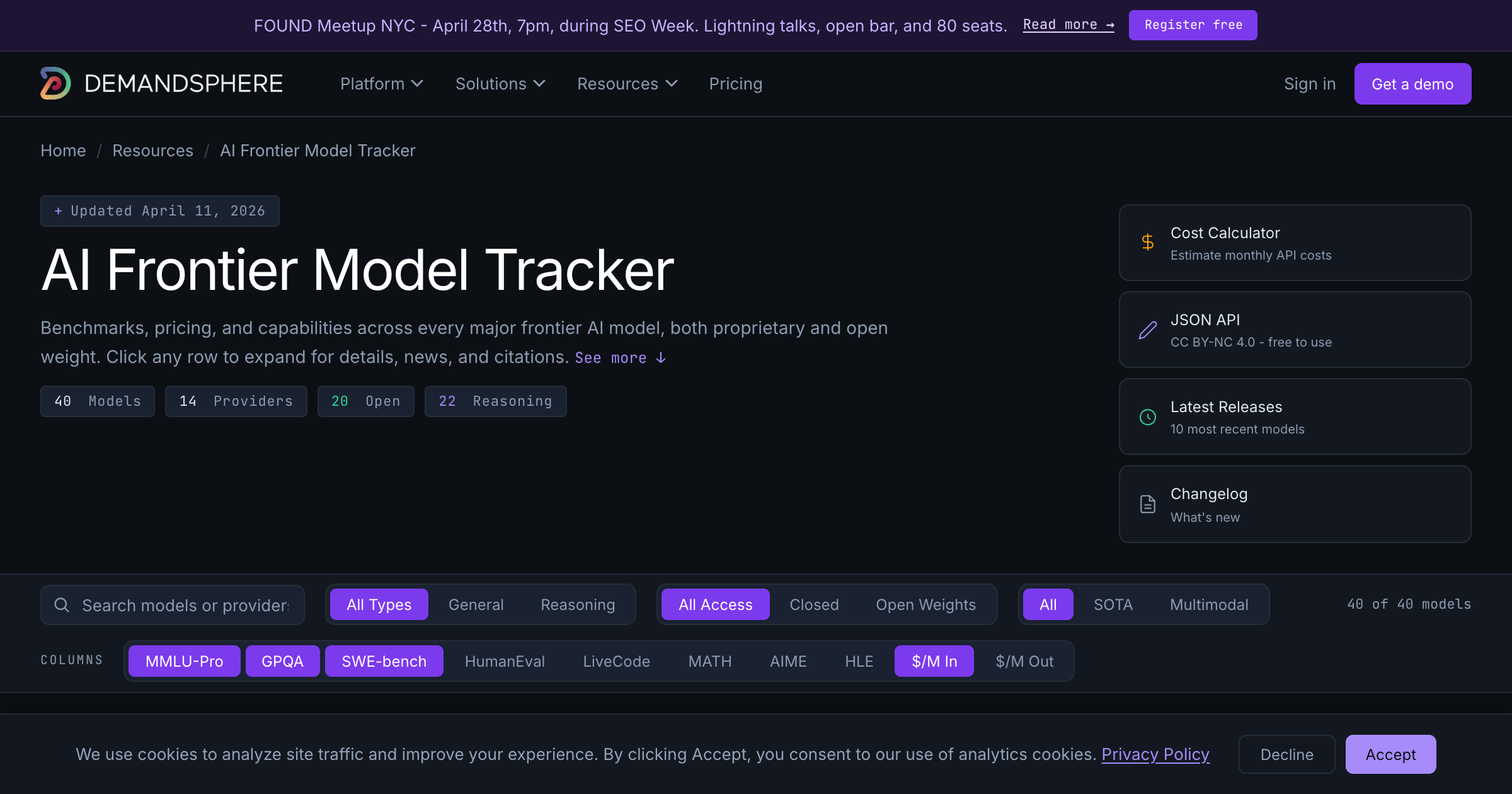
The AI Frontier Model Tracker is a free AI model comparison tool and leaderboard covering 42 frontier large language models (LLMs) from 14 providers. It includes benchmark scores, enterprise AI pricing, context windows, parameter counts, and a free JSON API.
We built this tool because we had a need for it ourselves.
At DemandSphere, we track brand visibility across every major AI platform, including ChatGPT, Gemini, Perplexity, AI Overviews in the SERPs, AI Mode, and more.
Every time a new model dropped, we found ourselves cross-referencing benchmarks, pricing, and release dates across dozens of provider pages.
HuggingFace is amazing for many reasons, but it lists 900,000+ models with no focused frontier comparison.
Other existing trackers that we reviewed lacked the depth we needed for AI model selection.
We also wanted to limit it to the models that are most likely to be used by a large number of users, so having a limited number of a few dozen models is a key feature of the tracker.
It is important to understand how the performance and perceived performance of these models impacts user behavior, which is what we are ultimately tracking on AI search. They may seem like disconnected concepts but, in fact, the impact is very real.
For example, Claude has quite handily captured the attention of the earliest adopters away from ChatGPT, something that would not have necessarily been foreseen 6-12 months ago.
Some of it is about AI model performance, some of it is about surrounding toolsets, among other factors.
But we needed a way to start breaking out these various factors, so it was natural to start with AI model performance.
Which AI models does the tracker cover?
We cover 42 models from OpenAI (GPT-5.4, o3, o4-mini, GPT-4.1), Anthropic (Claude Opus 4.6, Claude Sonnet 4.6, Claude Sonnet 4.5), Google (Gemini 3.1 Pro, Gemini 3 Flash, Gemma 4), xAI (Grok 4.20, Grok 4.1 Fast), Meta (Muse Spark, Llama 4 Maverick, Llama 4 Scout), DeepSeek (R1, V3.2), Moonshot AI (Kimi K2.5), MiniMax (M2.7, M2.5), Mistral (Large 2), Alibaba/Qwen (Qwen3.5, Qwen3), Microsoft (Phi-4), Amazon (Nova Pro), Cohere (Command A), and Nous Research (Hermes 4).
Every model has verified release dates, parameter counts, context windows, API pricing, and benchmark scores. Citation URLs for each model have also been added.
The tracker covers both proprietary AI models and open-weight models, with download links for HuggingFace, Ollama, and Kaggle where available.
You can see exactly how each generation compares to its predecessor. For example: GPT-5.4 vs GPT-5 vs GPT-4.1, or Claude Opus 4.6 vs Claude Opus 4.5.
The release timeline works as an AI model release calendar, showing every launch date with exact dates and provider logos. The RSS feed lets you subscribe for updates.
The default view shows models sorted by release date with GPQA Diamond, SWE-bench Verified, HumanEval, input pricing, and output pricing columns.
You can also customize this view for the benchmarks you care about by selecting your own set of columns.
How to compare AI model benchmarks
We spent a lot of time looking at the various benchmarks for relevance, saturation, and overall helpfulness in understanding performance.
There are currently 10 benchmark columns available in the tool, and we chose them based on what actually discriminates at the frontier in 2025 and 2026.
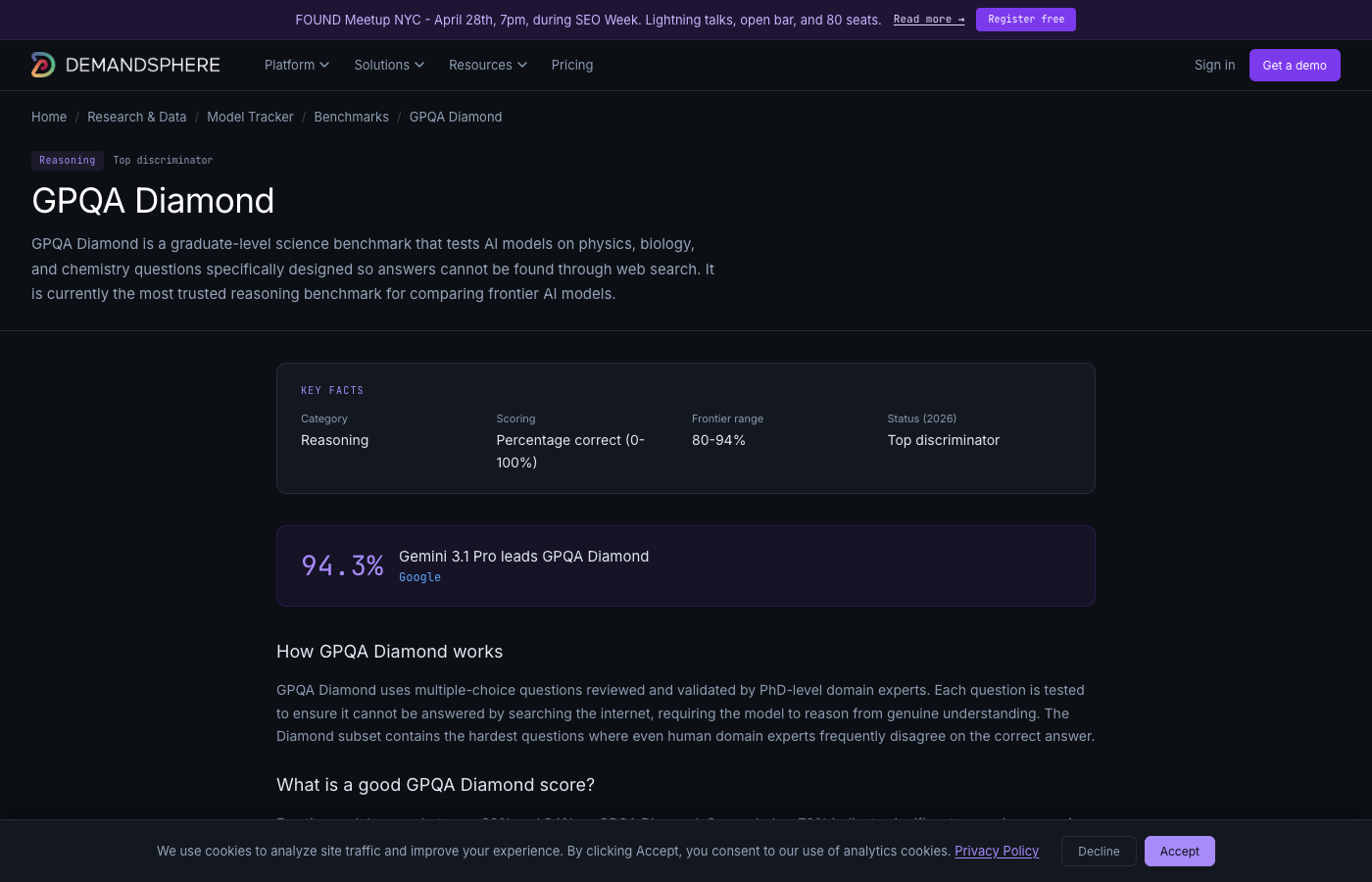
The reasoning benchmarks include GPQA Diamond (PhD-level science questions that can’t be Googled), HLE (Humanity’s Last Exam, the hardest standardized evaluation available), and MMLU-Pro (graduate-level knowledge across 57 subjects, widely recognized but saturating at the top).
For coding, the tracker offers SWE-bench Verified (real GitHub issue resolution, the gold standard for AI agent evaluation), HumanEval (Python code generation, near-saturated but still a useful baseline), and LiveCodeBench (competitive programming from recent contests, resistant to benchmark contamination).
The math benchmarks are MATH / MATH-500 (competition-level problems where reasoning models dramatically outperform general models) and AIME 2025 (American Invitational Mathematics Exam, the starkest separator between reasoning and general models at 83-100% vs 7-35%).
The final two columns show enterprise AI pricing: input cost and output cost per million tokens.
You can choose up to 5 visible columns at a time. Click any column header to sort.
We also wrote individual explainer pages for each benchmark covering what it measures, the score ranges, and which models lead.
Here’s a snapshot of the top models across the most important benchmarks:
| Model | Provider | GPQA Diamond | SWE-bench | $/M In | $/M Out |
|---|---|---|---|---|---|
| Gemini 3.1 Pro | 94.3% | 80.6% | $2.00 | $12.00 | |
| GPT-5.4 | OpenAI | 92.0% | n/a | $2.50 | $15.00 |
| Claude Opus 4.6 | Anthropic | 91.3% | 80.8% | $5.00 | $25.00 |
| Gemini 3 Flash | 90.4% | 78.0% | $0.50 | $3.00 | |
| Muse Spark | Meta | 89.5% | 77.4% | free | free |
| Claude Opus 4.5 | Anthropic | 87.0% | 80.9% | $5.00 | $25.00 |
| Grok 4.20 | xAI | 88.5% | 76.7% | $2.00 | $6.00 |
| Qwen3.5 397B | Alibaba | 88.4% | n/a | $0.60 | $3.60 |
Detailed AI model comparison for every model
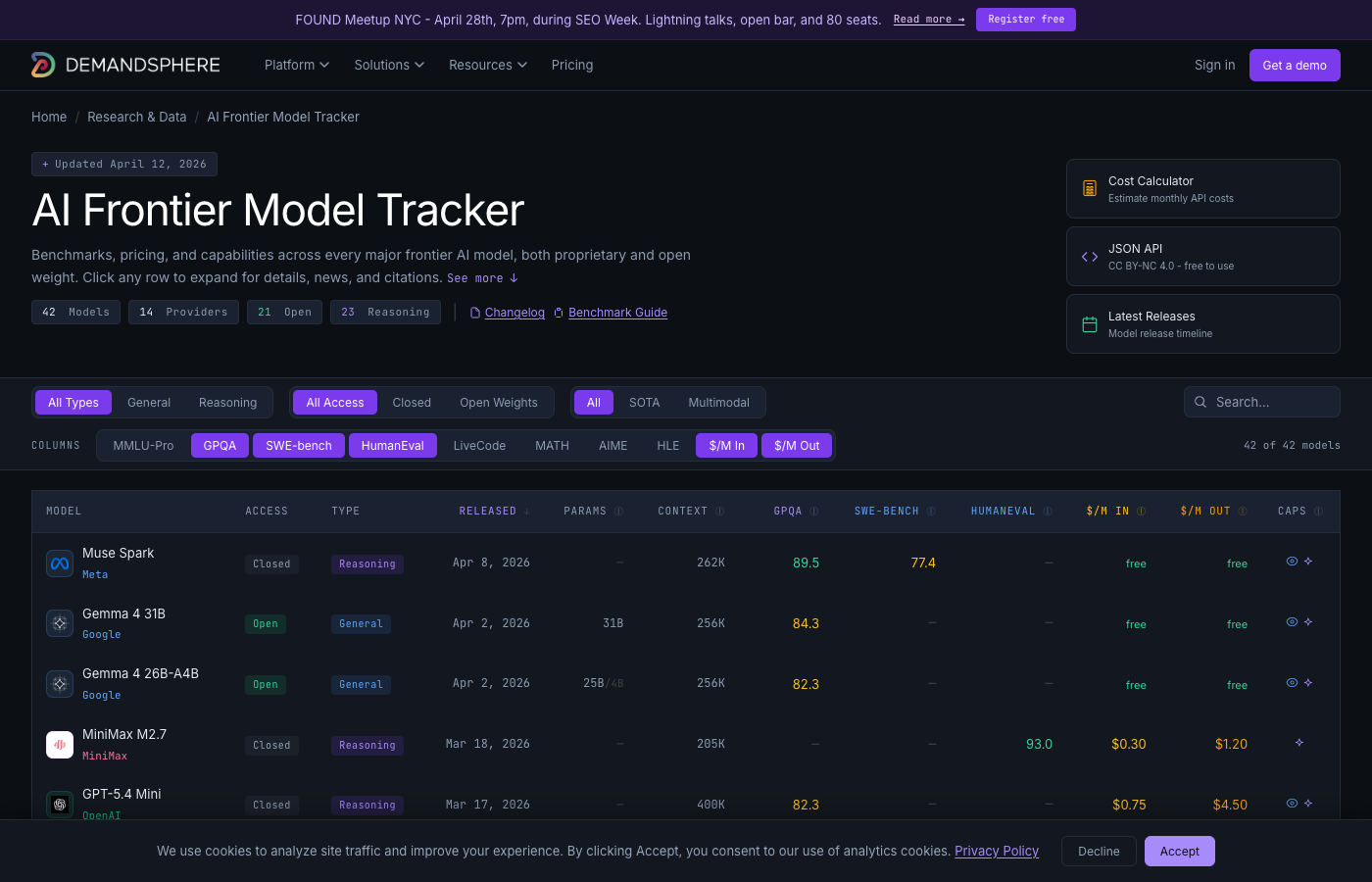
You can click any model to expand its detail panel. This will reveal:
- Stats cards with release date, context window, parameter counts, and pricing
- Benchmark bars for all 8 benchmarks (including which multimodal AI capabilities the model supports)
- A comparison chart showing the model vs. current-gen average vs. record holder
- Live news feed for that model
- Citation links to official documentation, blog posts, and technical papers
- Download weight links for open-weight models (HuggingFace, Ollama, Kaggle)
Whether you’re comparing a reasoning model like o3 against Claude Opus 4.6, or evaluating whether Llama 4 Maverick’s open weights justify the infrastructure cost vs. Gemini 3 Flash’s API pricing - the detail panel gives you everything in one place.
Which AI model is cheapest? The cost calculator
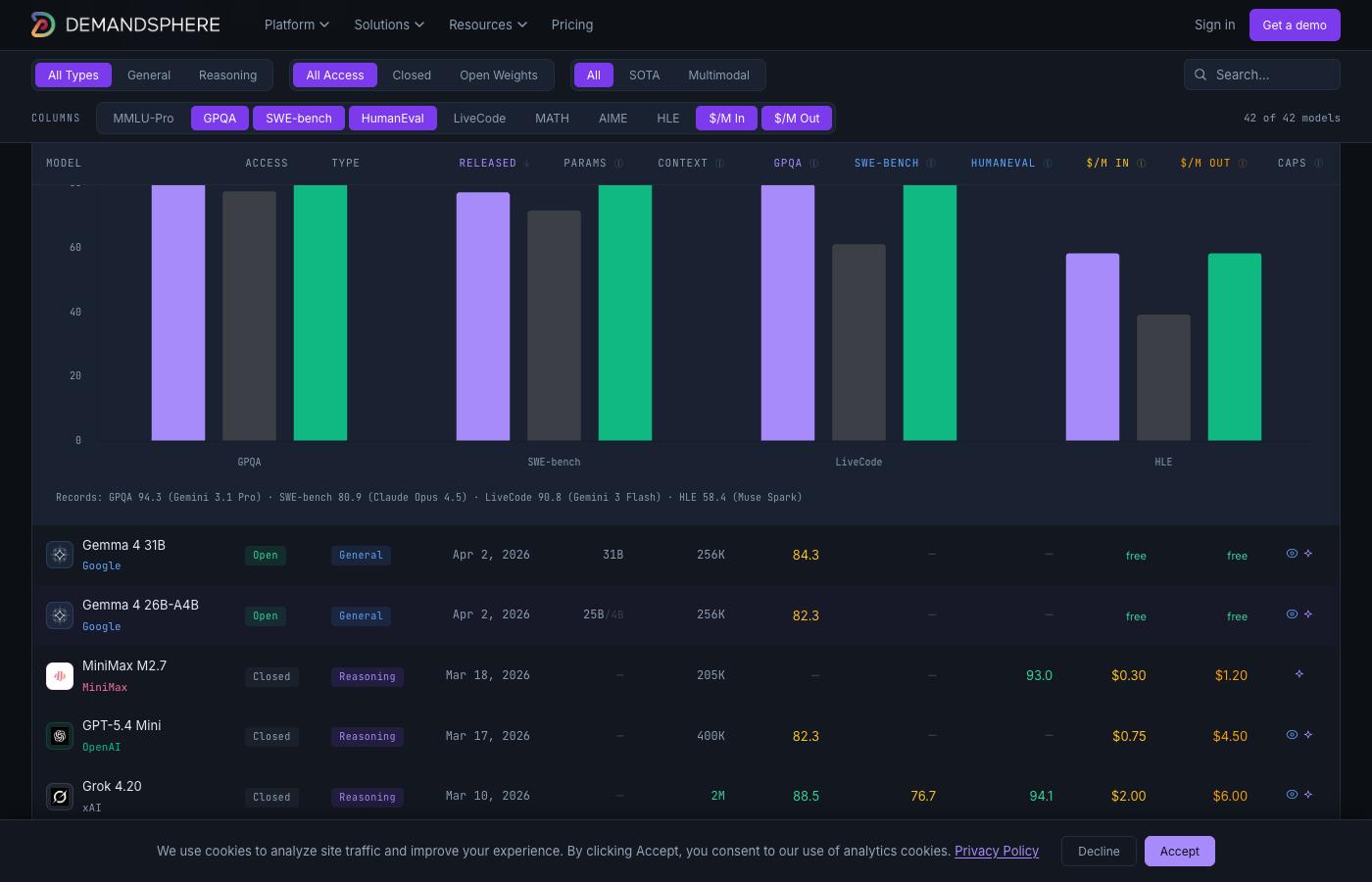
The cost calculator lets you enter your monthly token volume and see estimated costs across every model, sorted cheapest first. Each row shows the multiplier vs. the cheapest option so you can immediately see the cost delta between, say, GPT-5.4 at $2.50/$15.00 and Grok 4.1 Fast at $0.20/$0.50.
For enterprise teams running millions of tokens per month, the difference between models can be tens of thousands of dollars. The cost calculator makes that concrete and easy to visualize.
Free JSON API for AI API integration
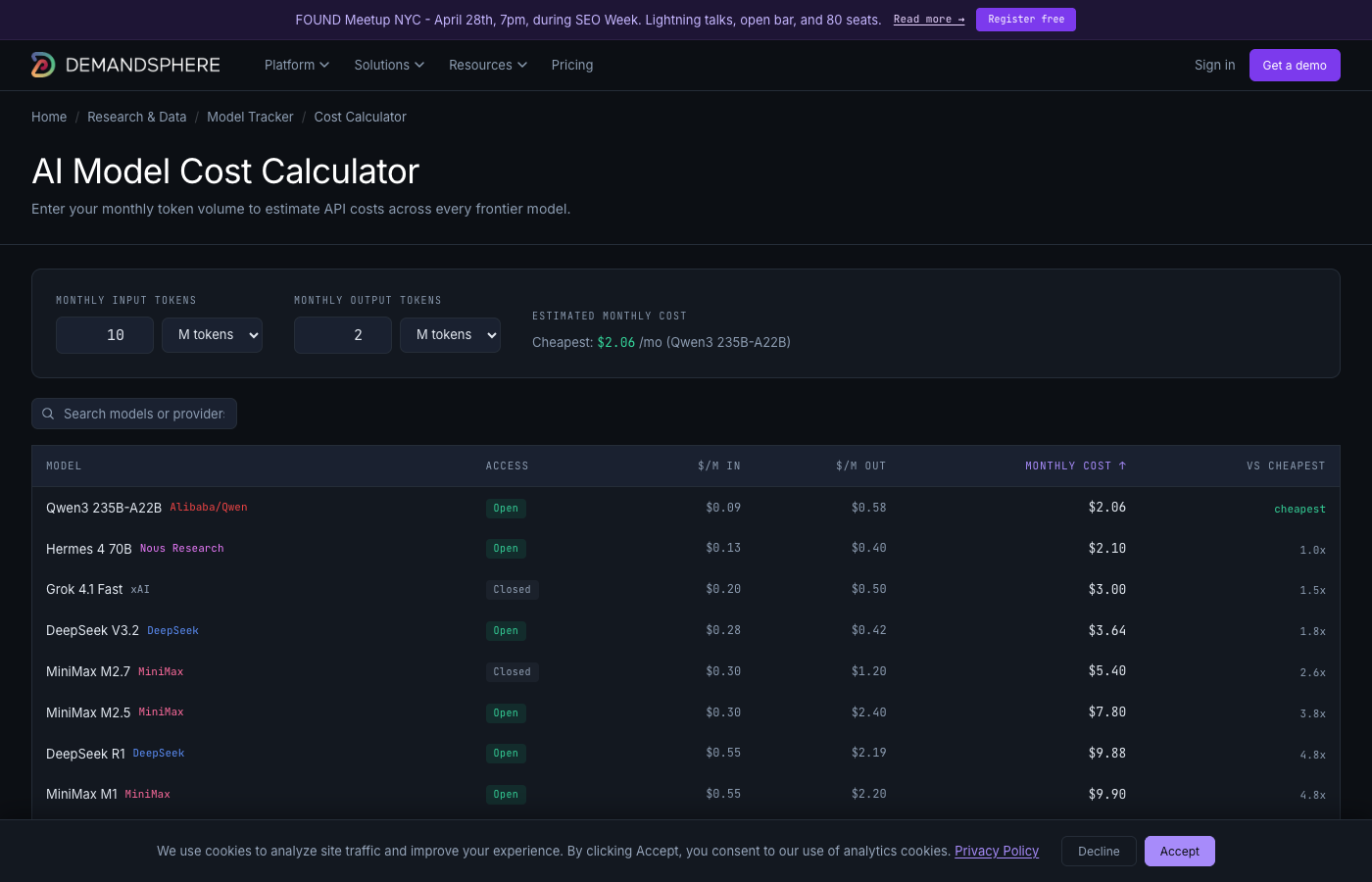
The full dataset is available as a free JSON API under CC BY-NC 4.0 license. No authentication, no rate limiting. The API docs page has copy-paste examples for curl, jq, JavaScript, and Python with syntax highlighting.
We built the JSON API because we wanted other tools, researchers, and competitive intelligence teams to be able to build on the data. If you use it, just credit DemandSphere and link back. The RSS feed for the release timeline lets you subscribe to new model announcements.
Why are MMLU benchmarks outdated for comparing AI models in 2026?
If you’re still sorting models by MMLU, you’re looking at an outdated picture.
AI industry trends in 2025-2026 have made older benchmarks nearly useless for frontier comparison.
MMLU-Pro is near-saturated at the frontier.
Top large language models cluster between 83-90% with little meaningful discrimination. HumanEval is even worse, with most frontier models above 90%. The model evaluation methodology needs to evolve with the models.
GPQA Diamond has become the most trusted reasoning benchmark because it produces meaningful 15-point spreads between top models.
Gemini 3.1 Pro leads at 94.3%, while GPT-4.1 scores 66.3%.
That kind of range actually helps you make a decision.
MMLU-Pro’s 7-point spread at the top does not.
For coding, SWE-bench Verified is now the standard. It measures real GitHub issue resolution, not isolated function generation, making it the closest benchmark to actual AI agent capability in production. Claude Opus 4.6 and Gemini 3.1 Pro lead at roughly 80%.
Humanity’s Last Exam (HLE) serves as the frontier ceiling test.
Meta’s Muse Spark scored 58.4% in contemplating mode, and Gemini 3.1 Pro leads at 41% in standard mode.
These intentionally low scores mean the benchmark will remain useful for years.
AI benchmark contamination is not a factor because the questions require deep specialist knowledge.
LiveCodeBench rounds out the picture for coding evaluation.
It draws problems from recent competitions that postdate model training, making memorization and benchmark contamination impossible.
We default to GPQA Diamond, SWE-bench, and HumanEval, but you can swap in any combination that matches your AI model selection criteria.
Our benchmark guide explains each one in detail.
How does the AI Frontier Model Tracker connect to brand visibility?
We monitor many of these models in DemandSphere’s AI visibility platform, and we are always adding more.
When ChatGPT, Gemini, Perplexity, or some other AI search engine answers a question about your industry, we track whether your brand appears in the response, how prominently it’s cited, and how that changes over time.
This is the connection between the tracker and our platform: if you’re evaluating which large language model to build on or which AI agent to deploy, you should also understand how that model sees your brand.
How often is the AI model tracker updated?
The tracker updates at least weekly and when major models drop. Meta’s Muse Spark launched on April 8 and was in the tracker the same week. Cohere’s Command A, Google’s Gemma 4, and Alibaba’s Qwen3.5 were all added within days of release.
We run weekly checks across all 15 provider blogs and monthly enterprise AI pricing verification passes.
Subscribe to the RSS feed or sign up for email updates on the tracker page to get notified when we add new models or update benchmark scores.
How we verify AI model benchmark scores
We cross-reference provider announcements, technical reports (arXiv papers), and independent evaluation platforms like vals.ai, Artificial Analysis, and llm-stats.com.
When providers don’t publish a specific benchmark (for example, Meta didn’t publish HumanEval or MATH scores for Llama 4), we show a dash instead of guessing.
When self-reported scores diverge from independent evaluations, we note the discrepancy.
All 42 models have exact release dates verified against at least two independent sources.
Pricing is checked monthly against provider pricing pages.
We also track model deprecation schedules where providers have announced them (for example, GPT-5.2 retires June 5, 2026). The full citation list for each model is accessible in the Citations tab when you expand any row.
What’s next for the AI Frontier Model Tracker
We’re planning per-model standalone pages for every large language model in the tracker, head-to-head AI model comparison pages (GPT-5.4 vs Claude Opus 4.6, open-weight models vs proprietary AI models, etc.), and a comprehensive “How to choose an AI model” guide for enterprise teams covering AI model selection criteria for different use cases.
We have other research and data tools in the works, so be sure to sign up for our newsletter and follow our blog for future announcements.